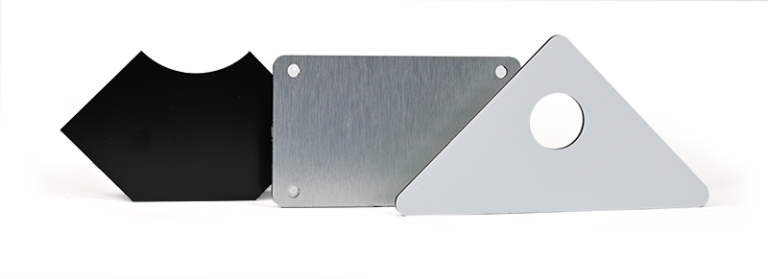
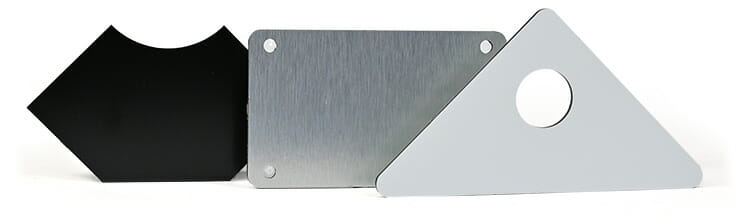
Custom CNC machined parts from ACM panel in white, brushed and black

Custom Cut ACM panel

SendCutSend’s ACM, or Aluminum Composite Material (sometimes called e-panel or DiBond®) is a low-cost, lightweight cousin to aluminum. This material should be on your mind if you need something both lightweight and inexpensive. Our ACM (DiBond®) comes in matte white, matte black, or brushed finishes.

Custom CNC machined parts from ACM panel in white, brushed and black

ACM Panel size and thickness options

Min/max sizes for cutting:

Instant quote
A: 1″ x 2″
B: 30″ x 44″

Custom quote
C: 30″ x 47″

Available Thicknesses:

.118″ (3.0mm)
.236″ (6.0mm)

SendCutSend offers this material with clearly defined size and thickness options. For instant quoting, the smallest part size available is 1″ x 2″, while the largest part supported is 30″ x 44″. For larger projects, custom quotes are available for sizes up to 30″ x 47″.

ACM Panel material details and specifications

.118" ACM Panel

Material Details & Specifications

.236" ACM Panel

Material Details & Specifications

3.0mm ACM Panel

Material Details & Specifications

6.0mm ACM Panel

Material Details & Specifications

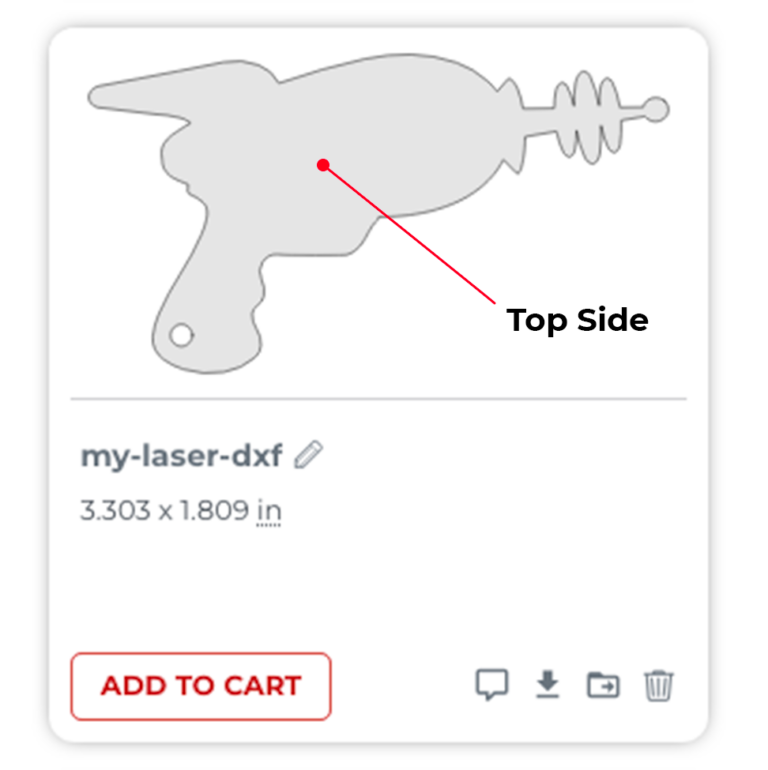
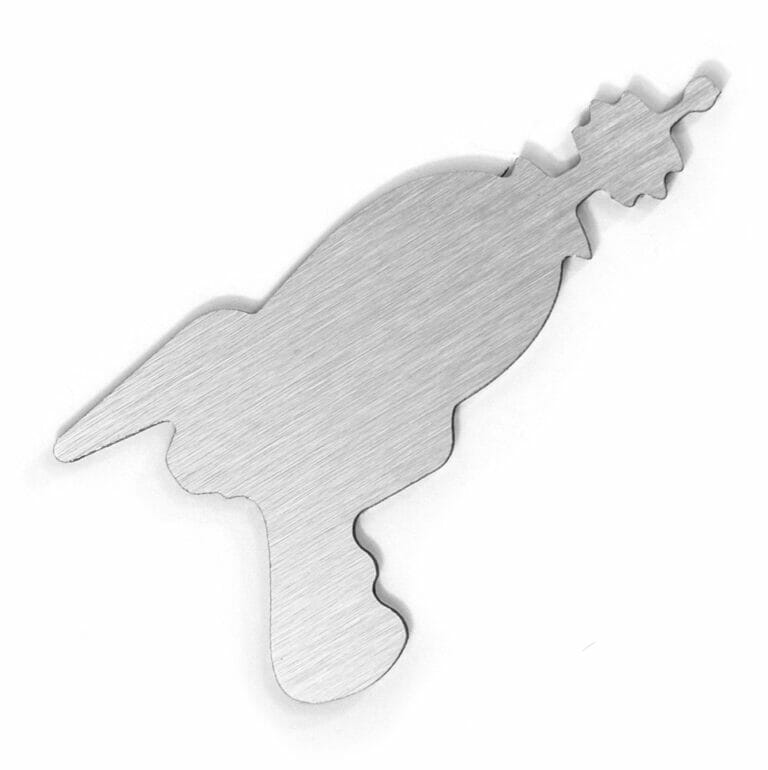
Brushed ACM panel is single sided

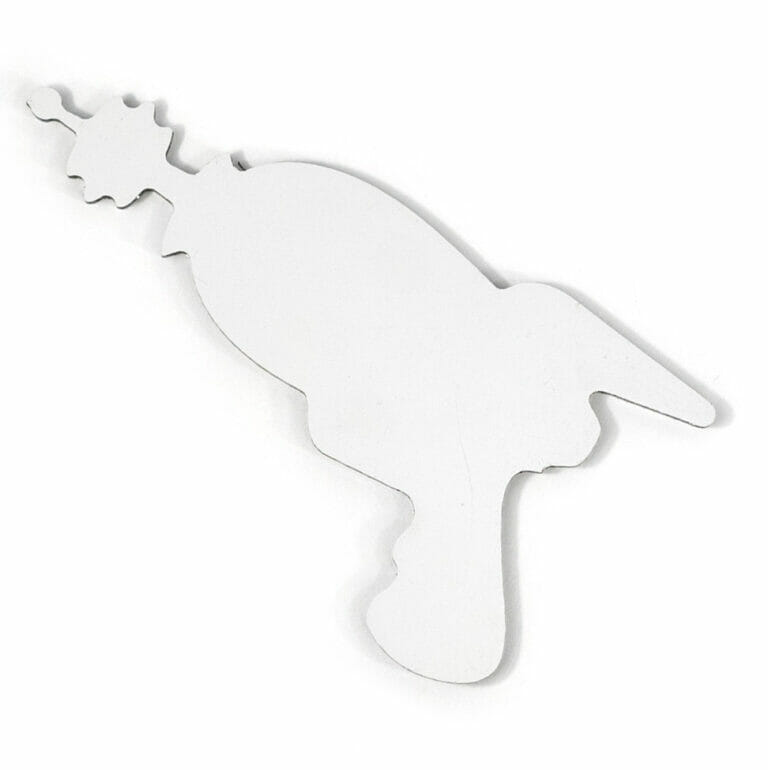
The back side of our brushed ACM has a dull, gray finish. We will cut your file brushed side up.

The orientation of your part as shown in the part preview will be considered the top side.

*Please note, we cannot guarantee that brushed ACM parts in your order will all have the same grain direction. Custom grain direction is not available at this time.

What to expect

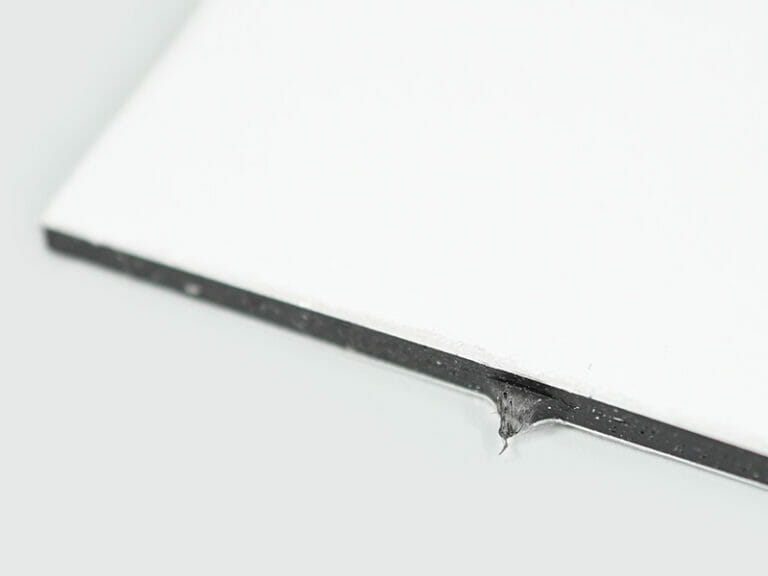
Plastic, composite, and wood materials cut on our CNC machine will have small tabs.

These tabs hold your parts in place while being cut to ensure the best accuracy possible. Learn what to expect and how to best design with these tabs in mind.
Get started with instant pricing with a sample file!

Get started with instant pricing!

SendCutSend's ACM Panel comes in black, white and brushed aluminum for CNC machining

What is ACM Panel?

While ACM Panel looks like aluminum, it weighs half the amount. Often used in construction as building cladding, ACM (DiBond® / e-panel) is a powerful material for obtaining strength and aesthetics in your building renovation, visual merchandising, or machine enclosures.

Custom cut ACM (DiBond®)

ACM’s popularity comes from its metallic properties, which are achieved by taking two thin layers of aluminum sheeting and sandwiching them with a polyethylene core. The plastic core allows ACM to be about half the weight of a traditional aluminum sheet, while maintaining desirable characteristics found in solid aluminum alloys.

ACM is made up of around 80% or more recycled materials, so if going green is important to you or your customers, ACM panels are a great choice.
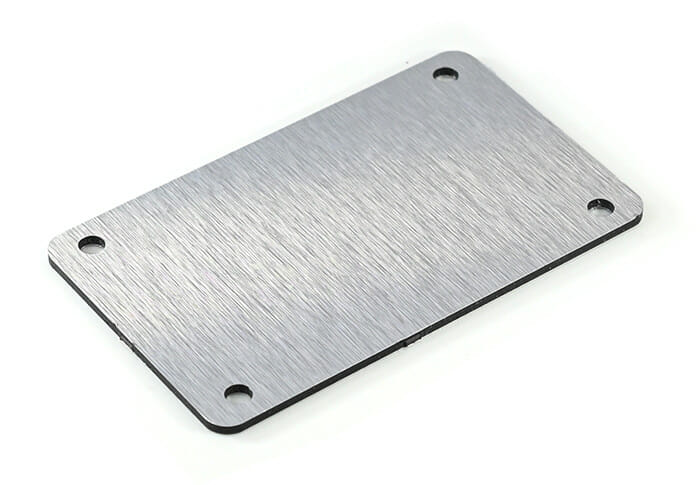
SendCutSend offers brushed ACM panel for CNC machining

What can you make with ACM Panel parts?

ACM DiBond®, finds extensive application across various industries and architectural projects due to its versatility and durability. Its lightweight nature coupled with high structural integrity makes it an ideal material for a variety of applications.

Our CNC machined ACM panel comes with a money back guarantee

We guarantee awesome quality parts. If you’re not 100% happy, we’ll give you a refund or remake on the spot – no questions, no hassle.
SendCutSend offers a money back guarantee on custom CNC cut ACM panel parts

ACM Panel FAQs

SendCutSend offers ACM Panel in two thickness options: .118″ (3.0mm), and .236″ (6.0mm).

SendCutSend offers ACM Panel with clearly defined size and thickness options. For instant quoting, the smallest part size available is 1″ x 2″, while the largest part supported is 30″ x 44″. For larger projects, custom quotes are available for sizes up to 30″ x 47″.

You can add the following services to your ACM Panel parts:
CNC Routing

Start your first SendCutSend project today!

Upload your CAD design, or try one of our customizable part templates to get instant pricing on your custom laser cut parts. All delivered to your door in a matter of days.

ACM panel: Lightweight rigidity for signage, enclosures, and structural skins

Aluminum Composite Material (ACM) is the go-to choice when a project needs a stiff, lightweight panel with a premium surface finish. By bonding thin aluminum skins to a polyethylene (PE) core, ACM delivers exceptional flatness and rigidity without the weight or cost of solid aluminum sheet.

Fabricators, makers, and builders rely on ACM for architectural panels, signage, machine enclosures, and decorative structures — anywhere you need a clean, professional look and stable geometry at a fraction of the weight of metal.

At SendCutSend, we CNC route ACM to ±.005” tolerance in .118″ (3mm) and .236″ (6mm) thicknesses, available in black, white, or brushed aluminum finishes. ACM’s smooth surface, dimensional stability, and affordability make it one of the most versatile composite materials we offer.

Key things to know about ACM panel

  • Aluminum + composite core: ACM consists of two aluminum skins bonded to a polyethylene core, making it rigid but extremely lightweight.
  • Excellent surface flatness: Ideal for printing, vinyl, graphics, and architectural skins.
  • Lightweight yet stiff: Stronger than plastics of similar thickness and much lighter than solid aluminum sheet.
  • Good weather resistance: Performs well outdoors with low expansion and minimal warping.
  • Clean, professional appearance: Available in black, white, and brushed aluminum finishes at SendCutSend.
  • Not meant for high structural loads: It’s rigid but not load-bearing — best for skins, covers, and panels.

What are the mechanical and physical properties of ACM panel?

ACM’s performance comes from the synergy of aluminum skins and a low-density core, resulting in excellent stiffness without increasing weight.

Why fabricators choose ACM panel

Fabricators choose ACM for a different reason than metals: it creates a finished, professional-looking panel with minimal post-processing, excellent flatness, and great stability.

  • Sign makers use ACM because it prints beautifully, resists warping outdoors, and stays flat for years.
  • Engineers and builders choose it when they need enclosure panels, covers, or skins that are light yet stiff.
  • Industrial designers like ACM’s clean surface, consistent finishes, and low cost compared to aluminum sheet.
  • Makers and hobbyists use it for cosplay, props, panels, and decorative elements because it’s easy to cut, drill, and mount.

ACM sits in the sweet spot between plastic and aluminum, combining the best traits of both while minimizing their weaknesses.

What are the strengths and advantages of ACM panel?

  1. High stiffness-to-weight ratio
    ACM panels are incredibly rigid for their weight. A 3mm ACM sheet is often stiffer than a same-thickness sheet of ABS or acrylic, but much lighter than aluminum.
  2. Excellent surface finish
    The front and back skins provide a premium look without additional finishing. The brushed aluminum surface in particular has a modern, professional aesthetic.
  3. Great for indoor and outdoor use
    ACM panels resist moisture, UV exposure, and moderate temperature changes.
  4. Cost-effective alternative to aluminum
    For applications where the panel is not structurally loaded, ACM provides the look of metal at a significantly lower cost.
  5. Vibration dampening
    The PE core absorbs light vibration, making ACM ideal for machine covers, acoustic panels, and enclosures.
  6. Easy to mount and fabricate
    It drills cleanly, holds screws well (with proper backing), and routes smoothly on CNC machines.

What are the limitations of ACM panel?

  1. Not load-bearing
    ACM is rigid but not strong enough for structural components. If you need real strength, consider 5052 aluminum or 6061 aluminum.
  2. Limited thermal tolerance
    The PE core can soften around 176°F (80°C). Not suitable for high-heat environments or parts near engines, exhausts, or heating elements.
  3. Not suitable for bending with tight radii
    ACM can be bent using V-grooving techniques, but tight bends can fracture the aluminum skins or delaminate the core. SendCutSend does not currently offer bending services for ACM.
  4. Edges expose the composite core
    If the appearance of exposed polyethylene is an issue, additional edging or trim may be required.
  5. Not anodizable or powder coatable
    The surface finish comes from the manufacturer and is not meant for post-treatments like metal alloys.

Fabrication and CNC routing considerations for ACM panel

Cutting and tolerances

We CNC route ACM to ±.005”, ensuring consistent, clean edges. Routing is the preferred method because lasers can melt or distort the polyethylene core.

Edge condition

  • Routed edges are smooth and uniform.
  • The internal black core gives edges a two-tone appearance on black or white panels.
  • The brushed aluminum finish may show a slightly different tonal edge from the routed area.

How to design ACM panel parts for manufacturability

To ensure your parts perform well:

  • Keep minimum feature sizes larger than the material thickness.
  • Avoid very thin tabs or long unsupported sections.
  • Use fillets to reduce the risk of chipping or stress points.
  • Design with the knowledge that edges will be “open” showing the composite core.

See more in SendCutSend’s design guidelines.

Fastening and joining options for ACM 

ACM can be joined using:

  • Screws (with large washers)
  • Rivets
  • Double-sided tape
  • Adhesives (including VHB tape)

Avoid welding or brazing, the PE core will melt. 

Use cases and applications for ACM panel

ACM shines in projects where lightweight stability and visual quality are top priorities. Typical applications include:

  • Signage and display panels
  • Architectural cladding and decorative skins
  • Machine enclosures and covers
  • Exhibit and trade show structures
  • Cosplay, props, and scenic design
  • Backdrops, panels, and interior partitions
  • Instrument panels and surface-mounted control plates

If you need a panel that stays flat, light, and visually clean, ACM is one of the best choices available.

When should you use ACM panel in your project?

Use ACM when your design requires rigid, lightweight panels with a clean, professional finish, especially for signage, enclosures, or decorative applications. It’s ideal when you want the look of metal without the weight or cost — and when the part won’t be subjected to heavy structural loads or high temperatures.

At SendCutSend, our CNC-routed ACM parts ship in 2–4 days, cut to ±.005” tolerance, with your choice of black, white, or brushed aluminum finishes. Whether you’re building a display, covering machinery, or fabricating a lightweight panel system, ACM provides the durability and aesthetics your project needs.