
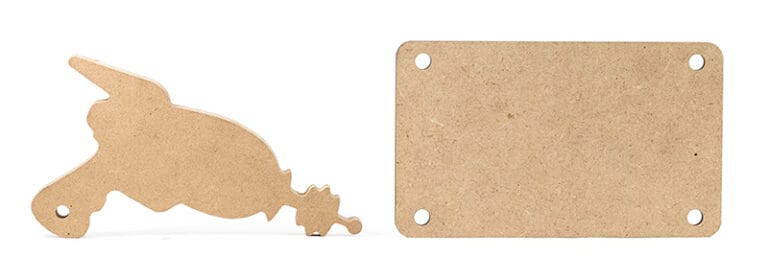

Laser cut, +/- .005" tolerance, CNC routed +/- .009"
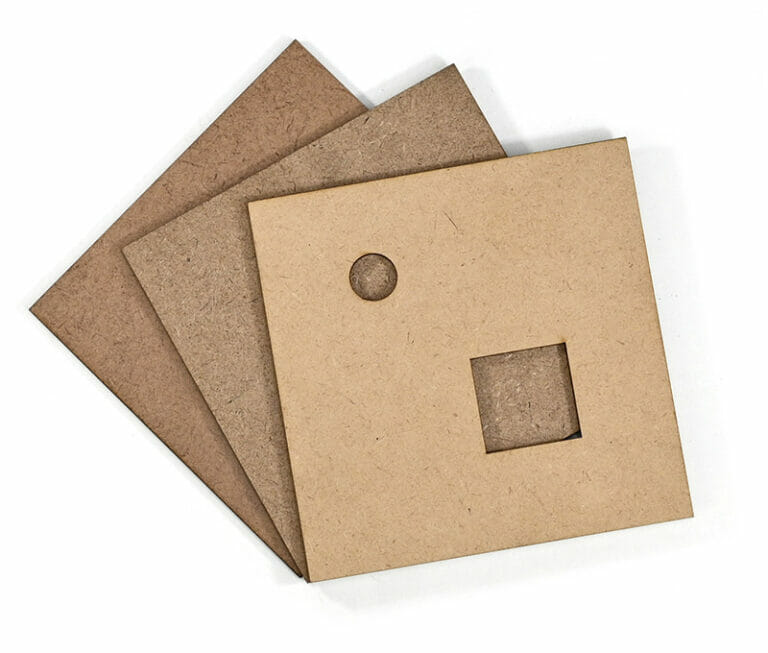
Due to ongoing global supply chain shortages, there will be variations in your custom cut MDF finish color and texture. Some variations of MDF may be darker and have a slight sheen, as shown in the images here. These darker variations will also have a dark cut edge and differing edge cut finish from our traditional MDF.
These finish variations will not alter the integrity of your parts in any way, but be aware that if you have multiple MDF parts in a single order, those parts may slightly vary in color and finish.
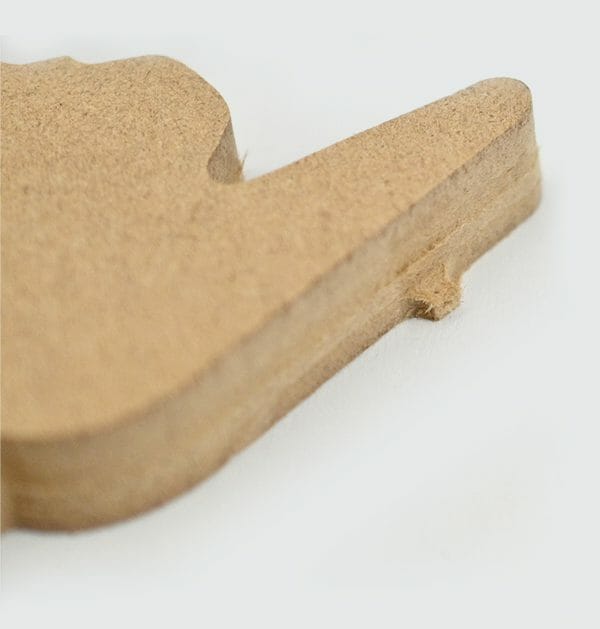
These tabs hold your parts in place while being cut to ensure the best accuracy possible. Click below to learn what to expect and how to best design with these tabs in mind.
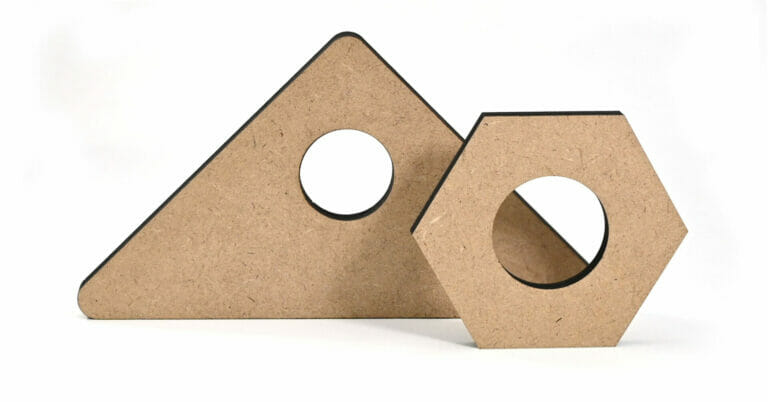
Our MDF, or Medium Density Fiberboard, is a unique composite wood material made from sawdust and fibers from both softwoods and hardwoods. These components are mixed with resin and then subjected to forming by extreme temperature and pressure, creating a spectacularly pliant and workable sheet material.
There’s a lot of information out there about real wood being superior to particleboard and MDF, but like with most projects, it really depends on what you need it for. The truth is MDF board functions about as well as, if not better than plywood for many project types. The key is knowing what you need from your board.
It should be noted that MDF is not ideal for external environments where it’d be subjected to the elements, as the material will warp and quickly fall apart. Although if you need a more accessible material for furniture, custom sound systems, or other indoor application, MDF will save you tons of cash in the long run and provide the same quality as a similar strength wood.
If you’re worried about off-gassing and potential liquid spillage ruining your finish, our MDF is treatable for a variety of purposes, such as fire resistance, liquid sealing, and different paints
We guarantee awesome quality parts. If you’re not 100% happy, we’ll give you a refund or remake on the spot – no questions, no hassle.
SendCutSend offers MDF in four thickness option: .125″(3.18mm), .250″(6.35mm) , .375″ (9.50mm), and .500(12.7mm).
When ordering MDF parts through SendCutSend, there are specific size and thickness parameters to keep in mind. For instant quoting, the smallest part size available is .25″ x .375″, while the largest part supported is 30″ x 44″.
The following cutting methods are available for MDF parts:
CNC Routing or Laser Cutting

We accept .ai, .dxf, .dwg, .eps, .stp, and .step

Customize one of our simple parts templates

Medium Density Fiberboard, commonly called MDF, is a smooth, uniform, engineered wood panel made from wood fibers and resin that are pressed into dense, stable sheets. Makers, fabricators, and engineers use MDF for prototypes, fixtures, jigs, signage, furniture components, and decorative parts because it cuts cleanly, sands easily, and provides a flat, consistent surface for painting or finishing. At SendCutSend, we laser-cut and CNC route globally-sourced MDF in .125 inch to .500 inch thicknesses, with the cutting method selected automatically based on thickness and design geometry. Parts are produced with ±.005 inch tolerance for CNC routing and ±.009 inch tolerance for laser cutting, providing predictable, repeatable results for both functional and aesthetic projects.
Fabricators choose MDF because it provides a combination of smoothness, consistency, and affordability that is difficult to match with natural wood. There are no knots, voids, or grain patterns to work around, and the panel remains stable and uniform across its entire surface. Designers appreciate that the face finish looks clean and is easy to customize with paint, vinyl, engraving, tooling, or scoring. Common reasons people select MDF include: • It cuts predictably and cleanly. • It is ideal for prototypes due to its low cost. • It provides a flat, consistent painting surface. • Interior details, pockets, and patterns cut clearly. • It is available in thicknesses suitable for both delicate and structural components. MDF is a staple material for indoor projects where consistency and surface quality matter more than natural wood appearance.
MDF laser cuts well in thinner gauges and is one of the most widely tested and used materials for laser projects. What to expect from laser cutting MDF: • Clean, sharp edges • Consistent cutting across the entire sheet • Moderate edge darkening • Some smoke or soot that can be cleaned or sanded • Fine detail possible on .125 and .250 inch thicknesses Laser cutting is suitable for most 2D shapes, lettering, decorative cutouts, precision stencils, and interior features. For thicker sheets or complex parts where burning is a concern, SendCutSend will automatically switch to CNC routing.
The cutting method depends on both design and thickness. MDF tends to char under long laser exposure, so CNC routing is chosen when needed for clean results. Typical process assignments: • .125 inch to .250 inch MDF is usually laser cut • .375 inch to .500 inch MDF is usually CNC routed • Routing is used for thicker sheets or when geometry includes pockets or chamfers • Laser cutting is used for fine detail and clean internal features The SendCutSend quoting system automatically selects the best process for the material and design.
MDF has no knots, voids, or grain direction. This makes it excellent for painting, vinyl application, engraving, and decorative finishes.
Because MDF is homogeneous, both laser cutters and CNC routers produce consistent edges and geometry across the sheet.
MDF is cost-effective, allowing designers to test concepts before moving to more expensive materials like birch plywood or acrylic.
It provides a clean finish and is used extensively in cabinetry, retail displays, and interior architectural features.
MDF handles intricate laser cut patterns, routed pockets, and fine internal geometry without tear-out.
MDF absorbs water and will swell or warp if exposed to moisture. For outdoor use or wet environments, consider: • HDPE • Acrylic • Polycarbonate
MDF creates fine dust during routing. SendCutSend manages this internally, but users should consider it when sanding or modifying parts.
MDF is denser than plywood, which can be an issue for large components.
Light scoring is fine, but deep engraving or slow cuts will leave heavy darkening.
MDF is intended to be painted or finished and does not have the wood grain appearance of birch or hardwood.
MDF is easy to design for, but following a few guidelines improves quality and part longevity.
Check out SendCutSend Design Guidelines for more tips on setting up your file for cutting with SendCutSend.
MDF is used in woodworking, fabrication, retail displays, makerspaces, and prototyping across many industries. Typical applications include:
Its versatility and affordability make it useful for both small creative projects and large-scale production runs.
Choose MDF when you need an inexpensive, smooth, stable board for indoor applications that require clean cutting, easy finishing, and predictable behavior. MDF is ideal for:
MDF is not the right choice for:
SendCutSend laser cuts or CNC routes MDF in thicknesses from .125 inch to .500 inch with 2 to 4 day lead times, providing clean, ready-to-use parts for both creative and functional projects.


